Key Takeaways
- EPF Scheme 2026 replaces the 1952 Scheme.
- Contribution rates remain unchanged.
- AMNESTY 2026 provides eligible PF trusts with an opportunity for retrospective regularisation.
- VISHWAS 2026 enables settlement of eligible Section 14B damages.
- Fraud-related matters remain outside the Scheme.
- HR, Finance, Legal, and Compliance teams should review historical PF matters before the application window closes.
Over the years, Vishwanath B G, Vice President – Retirement Benefit Consultation, and Uttiya Das, Vice President – Sales, at TeamLease RegTech have worked closely with private provident fund trusts across industries. In that time, a familiar pattern has emerged. A trust established decades ago. Recognised by the Income Tax Department. Operating smoothly, crediting members correctly, and undergoing annual audits without issue. Yet, buried somewhere in the records, one critical document is often missing: the formal exemption notification under Section 17 of the EPF Act.
The current leadership rarely had any role in creating this gap. That is precisely why it becomes so challenging when it eventually comes to light, usually during a due diligence exercise, a regulatory review, or a corporate transaction, when every compliance document suddenly matters.
Which is why, of everything in the new EPF Scheme, 2026 notified on 29 June, the two provisions we keep coming back to are not the ones getting the headlines. AMNESTY 2026 and VISHWAS 2026 are quieter than the digital claims overhaul, and considerably more useful if you are carrying history.
What has not changed
Contribution rates are where they always were. Twelve per cent from the employer, twelve from the employee, ten per cent for the categories that were always notified at that rate. Withdrawals genuinely did get simpler, with thirteen overlapping categories folded into three. Members can now access up to the full eligible balance, though a quarter of the corpus stays locked for partial withdrawals. That lock lifts at final settlement, retirement, permanent incapacity and emigration, so it restrains mid-career dipping rather than capping anything permanently. The waiting period for full settlement after leaving a job has gone from two months to twelve.
On the principal employer's liability for a contractor's PF default, we get asked about this constantly, so let us settle it. It is not new. That obligation has sat in the EPF Act and in judicial interpretation for years. What the 2026 Scheme adds is a far tighter documentary trail, which means the old defence of not having known is now considerably harder to run.
AMNESTY 2026
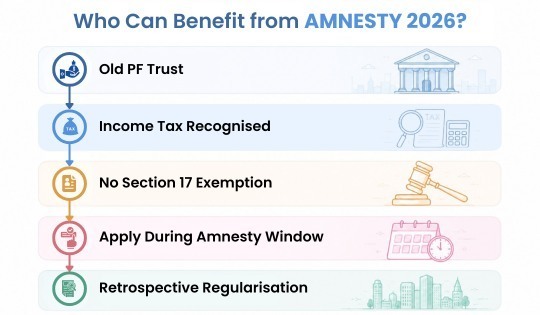
This one is for the trust in the opening paragraph. If your organisation runs a PF trust recognised under the Income Tax Act but never formally exempted under Section 17, AMNESTY offers retrospective regularisation running from the trust's inception up to a designated cut-off date.
There is a condition worth reading carefully. Pending assessments for dues, damages and interest stand withdrawn, but this relief is available where members have received contributions and interest at rates equal to or above the statutory rate. Most well-run trusts clear this comfortably. Some do not, and finding out which category you fall into is a two-day exercise, not a two-month one. EPFO has also waived the usual minimum headcount and corpus-size conditions for the purposes of this window.
VISHWAS 2026
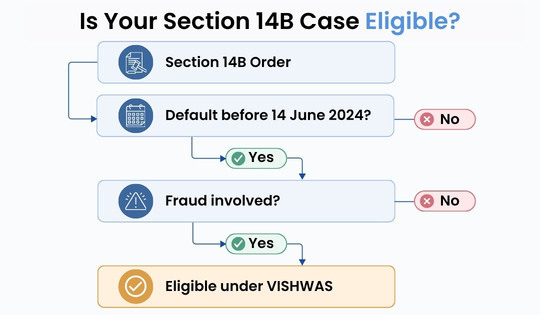
This is for the Section 14B damages notice that has been sitting in appeal since nobody quite remembers when. It allows settlement at concessional, graded rates, provided the underlying default relates to a period before 14 June 2024. Fraud, misappropriation and falsified records are excluded, so it is not a route out of genuine wrongdoing.
EPFO issued operational guidelines on 9 July and has set up dedicated VISHWAS Cells across zonal and regional offices. Applications go through the employer portal with a digital signature. The machinery is running.
Why now
Aadhaar-linked UANs, electronic returns and automated reconciliation are steadily making historical inconsistencies visible in a way they were not before. EPFO is offering six months of voluntary clean-up ahead of that. Sensible trade, for both sides.
The question we are still arguing about
Here is where we do not fully agree with each other, and we would genuinely like other views.
VISHWAS discounts the damages under Section 14B. It does not touch the interest under Section 7Q, and the position on that is clear enough: an establishment that has not fully remitted its statutory interest is simply not eligible. So the interest has to be cleared upfront, in full, before any settlement benefit applies.
For a short default, that arithmetic is trivial. For a default running across several years, the 7Q interest can dwarf the discounted damages, and you are effectively writing a large cheque today to close a matter that has been sitting dormant and unenforced for a decade. Whether that is worth doing is a commercial judgement, not a legal one. It turns on how much longer the matter would realistically stay dormant, what a due diligence team would make of it, and how the board views a contingent liability that never quite goes away.
We have run this calculation for a handful of situations now and it has gone both ways. What we have not found is a clean rule of thumb for where the line sits.
If you have worked through this for your own organisation, we would like to hear how you landed. The window closes six months from 29 June, so the arguing has a deadline.
Frequently Asked Questions
1. What is AMNESTY 2026 under the EPF Scheme 2026?
AMNESTY 2026 is a one-time regularisation window that allows eligible provident fund trusts recognised under the Income Tax Act, but lacking formal Section 17 exemption under the EPF Act, to seek retrospective regularisation, subject to the prescribed conditions.
2. What is VISHWAS 2026?
VISHWAS 2026 is a one-time settlement scheme that enables eligible employers to settle qualifying Section 14B damages at concessional rates, helping reduce prolonged litigation and compliance risks.
3. Has the EPF contribution rate changed under the EPF Scheme 2026?
No. The EPF Scheme 2026 does not change the statutory contribution rates. Employer and employee contributions continue at 12% each for most establishments, while certain notified establishments continue under the 10% rate.
4. Who should review AMNESTY 2026 and VISHWAS 2026?
HR leaders, CFOs, Company Secretaries, Legal teams, Compliance professionals, and organisations operating provident fund trusts or managing historical PF disputes should evaluate their eligibility under these schemes before the application window closes.
5. Are fraud-related cases covered under VISHWAS 2026?
No. Cases involving fraud, misappropriation, or falsified records are specifically excluded from VISHWAS 2026. Only eligible Section 14B matters that meet the Scheme's conditions can be considered for settlement.