Key takeaways
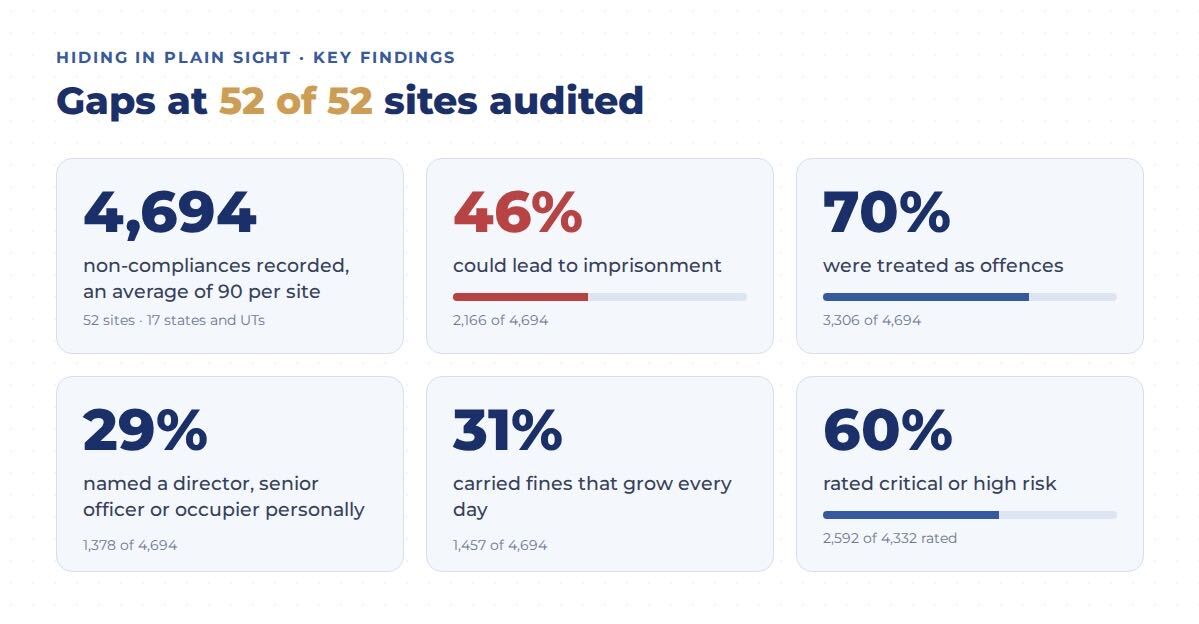
Gaps at every site: physical audits of 52 sites recorded 4,694 non-compliances, an average of 90 per site.
Serious consequences: 46% could lead to imprisonment, and 29% named a director, senior officer or factory occupier personally.
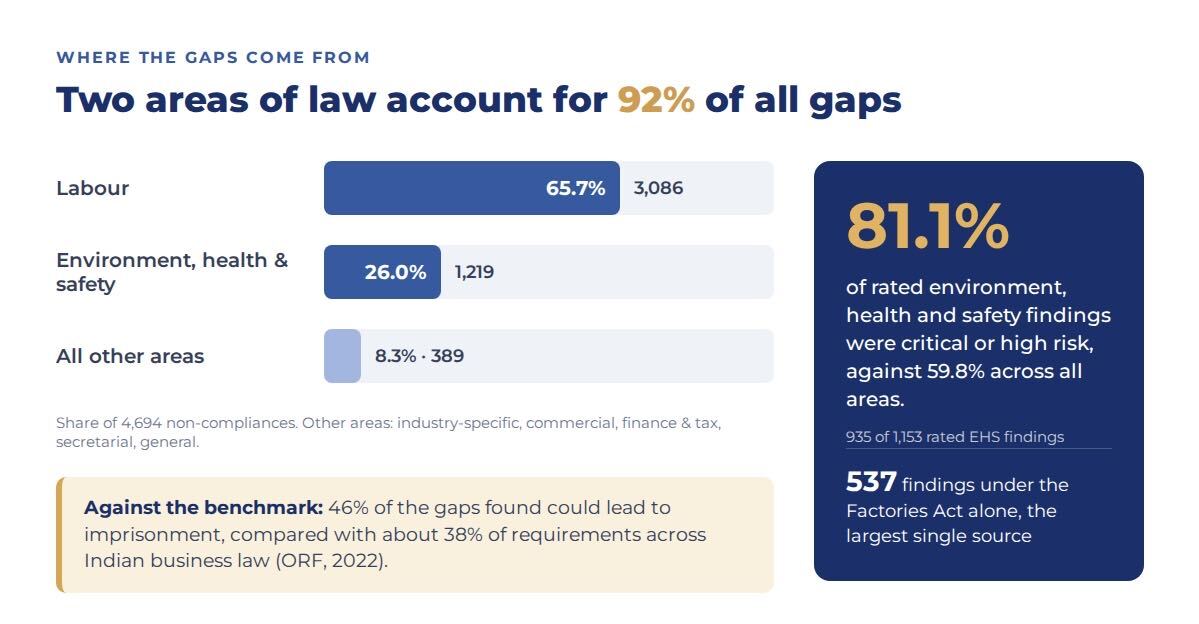
Two areas of law dominate: labour law and environment, health and safety account for 92% of all gaps.
Many are quick fixes: about half of all findings (2,482) relate to displays, registers, records, policies and appointments.
Desk reviews miss them: a physical audit shows what is actually in place at each site.
Most companies believe they are compliant. They have a compliance team, a calendar to track deadlines and a folder full of licences. But having these systems in place does not necessarily mean that compliance requirements are being met at every site. TeamLease RegTech’s report, Hiding in Plain Sight, highlights this gap. Based on physical audits of 52 sites across 17 states and union territories, the report found gaps at every site audited.
Not one site came out clean
The audits covered 28 factories, 12 warehouses and depots, six corporate offices and six mining and metals plants. Each company had sought an independent audit, yet the findings revealed gaps across all sites. Auditors recorded 4,694 non-compliances, averaging 90 per site. Factories had the highest average, with 124 findings per site, more than twice the number recorded at warehouses and offices. Corporate offices were not exempt, averaging 57 findings each, roughly the same as warehouses.
The risk is personal, not just financial
Many of these gaps go beyond paperwork. Under the laws in force at the time of the audits, 70% of the findings were classified as offences, while 46% could lead to imprisonment. In 29% of cases, a director, senior officer or factory occupier could be held personally responsible. Another 31% carried fines that increased with each day the non-compliance remained unresolved. Auditors also rated 60% of the findings assessed for risk as critical or high risk.
This exposure is often personal. Of the 1,378 findings that named individuals, 1,237, or nearly nine in ten, came from factories. Warehouses had the highest share of findings that could lead to imprisonment, at 52.1%. For warehouses, the report points to fewer supervisors, a larger contract workforce and greater distance from head office. Beyond penalties, authorities can also suspend licences or order closures, as cases such as Sterlite Copper in 2018 and LG Polymers in 2020 have shown.
Labour and EHS laws account for most gaps
Two areas of law accounted for 92% of all gaps: labour law (65.7%) and environment, health and safety (26%). Although the latter accounted for fewer gaps, the findings were more serious, with 81.1% of those rated classified as critical or high risk. These covered areas such as hazardous waste, fire safety, electrical safety and pollution approvals. The Factories Act alone accounted for 537 findings, 533 of which could lead to imprisonment. Overall, 46% of the findings carried a possible jail term, compared with around 38% across Indian business law.
The simplest gaps are the easiest to miss
The most common gaps are often the simplest to overlook. Auditors found 1,118 instances where notices, policies or summaries of Acts were not displayed, and 492 of these could lead to imprisonment. Workplace inclusion laws covering sexual harassment, disability, HIV and AIDS, transgender persons and maternity benefits accounted for 995 findings across 16 of the 17 states and union territories covered by the audits. About half of all findings (2,482) related to displays, registers, records, policies and appointments. Many of these gaps can be addressed quickly once they are identified.
The Labour Codes have changed the rules, not the duties
The regulatory landscape is also changing. India’s four Labour Codes came into force on 21 November 2025, replacing 29 central labour laws. While first-time offences now often attract fines instead of imprisonment, repeat offences can still lead to jail terms, and state rules are still catching up. Of the findings recorded in the audits, 1,768 (37.7%) fall under laws now covered by the codes. With 12,973 regulatory changes tracked in 2025, averaging more than 35 a day, companies that continue to use outdated registers, forms and notices may already be falling behind.
Why these gaps keep coming back
The report identifies six reasons why these gaps persist. Companies may be unclear about which laws apply to them, head-office policies may not reach individual sites, and contractors or smaller locations may be overlooked. Differences in state rules add to the difficulty, while risk is sometimes assessed based on the effort needed to comply rather than the consequences of non-compliance. In many cases, compliance is still treated as an annual exercise rather than an ongoing responsibility. A desk review or self-declaration can show what a company reports, but a physical audit reveals what is actually in place at the site.
Five steps to close the gaps
List what applies to each site. Identify the laws and licence conditions that apply to every site, based on its state and activity, using a compliance tracking system.
Fix the most serious gaps first. Prioritise those involving imprisonment, personal liability, daily fines or closure.
Check on the ground, regularly. Physical checks show what reports and uploaded documents cannot.
Include contractors and smaller sites. Cover them with the same process, and verify contractor compliance directly.
Keep proof at all times. Maintain dated, site-wise records as evidence of compliance.
Directors, in particular, need to be aware of the obligations that hold them personally responsible.
Reading the findings in context
These findings need to be read in context. The sample is not a national survey, and most findings came from factories (74%) and Maharashtra (47.6%). Companies that commission audits may also be more careful about compliance than those that do not. The extent of the problem across businesses could therefore be greater than the findings suggest. For companies, the priority is to identify and address these gaps before they come to the attention of an inspector, a worker or an investor.
Read the full report: Hiding in Plain Sight
Find your gaps before someone else does. Talk to our compliance audit team about a site-by-site audit.
Frequently asked questions
1.What is the Hiding in Plain Sight report?
It is TeamLease RegTech’s Compliance Audit Insights 2026 report, based on physical compliance audits of 52 sites across 17 states and union territories, covering factories, warehouses, corporate offices and mining and metals plants.
2. How many compliance gaps did the audits find?
Auditors recorded 4,694 non-compliances, an average of 90 per site. Every one of the 52 sites audited had gaps.
3. How many compliance gaps could lead to imprisonment?
Under the laws in force at the time of the audits, 46% of findings (2,166 of 4,694) could lead to imprisonment, compared with about 38% of requirements across Indian business law.
4. Which laws account for most compliance gaps?
Labour law accounted for 65.7% of findings and environment, health and safety for 26%. The Factories Act alone accounted for 537 findings.
5. Why is a physical compliance audit needed if we already track compliance?
Tracking systems and self-declarations show what a company reports. A physical audit checks registers, displays, licences, facilities and safety on the ground, where many gaps only become visible.